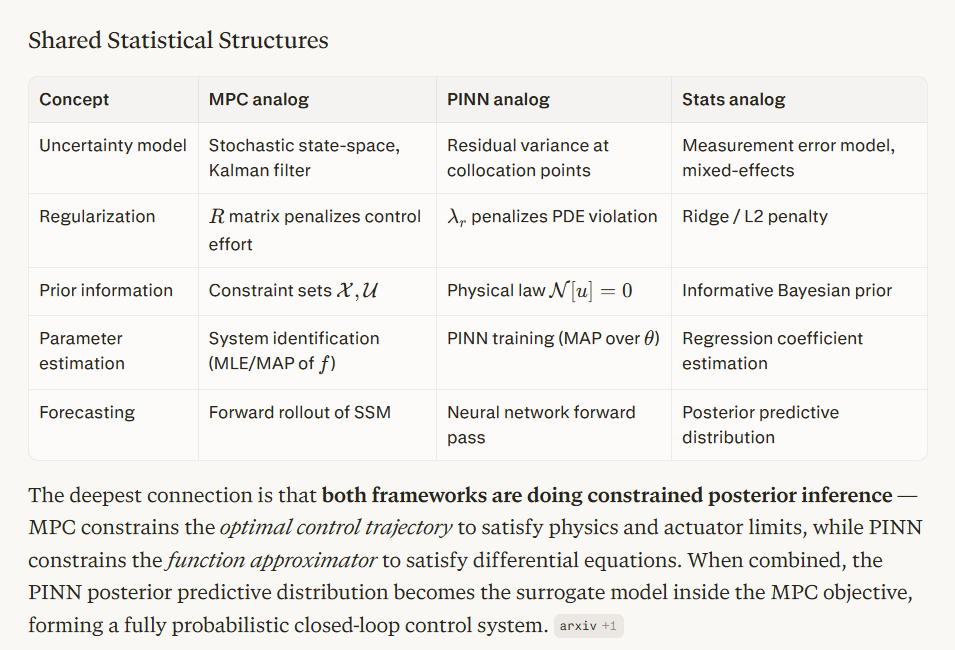
Where PINN+MPC Fits
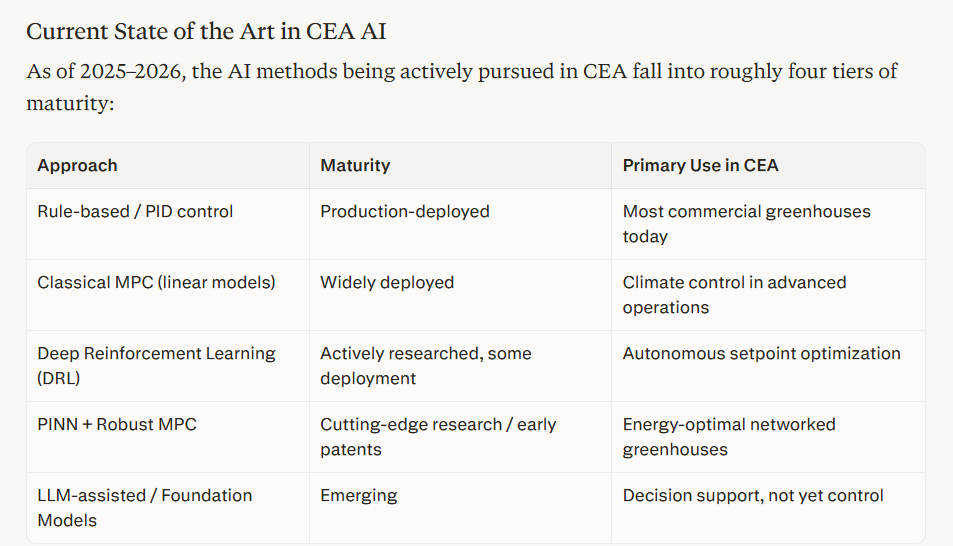
PINN+MPC is genuinely state-of-the-art in the academic and patent literature, with ScienceDirect papers from 2023 and active patents filed in 2024 showing real PINN-based Robust MPC frameworks for year-round CEA operation. The appeal is specific: traditional MPC needs an accurate plant model, and in sparse-data agricultural environments, PINNs provide a physically-constrained surrogate that doesn’t need thousands of labeled samples.
The Real Competition: Deep Reinforcement Learning
The most active challenger to MPC in CEA right now is Deep Reinforcement Learning (DRL). DRL bypasses the need for an explicit plant model altogether — it learns control policies directly from environment interactions — making it more flexible in highly nonlinear or poorly-characterized systems. A 2025 paper from ScienceDirect directly frames DRL as a “powerful alternative to MPC when accurate models are unavailable.”
Deep Learning RL for CEA. Reference:
https://www.sciencedirect.com/science/article/pii/S2772375525005581
The most exciting current direction is actually MPC-RL hybrids — using RL to learn or tune MPC cost function weights, combining the sample efficiency and interpretability of MPC with the adaptivity of RL. A 2025 greenhouse climate-control framework by Mallick et al. is cited in a May 2026 arXiv preprint as a notable recent example of this integrated approach.
Digital Twins as the Unifying Architecture
Increasingly, both PINN+MPC and DRL are being embedded inside digital twin platforms — virtual replicas of a greenhouse that are continuously synchronized with real sensor data. Digital twins act as the simulation environment in which MPC or RL agents are trained and tested before deployment, dramatically reducing the risk of damaging real crops. Cornell, Iowa State, and others have active programs building digital twin-based autonomous greenhouse platforms.
What’s Actually Running in Commercial Farms
Despite the research excitement, nearly 30% of commercial CEA growers only began exploring AI at all in 2024, per the CEA Census. The vast majority of production greenhouses still run simple rule-based or classical PID/linear MPC systems. Companies like Koidra are among the few deploying genuinely learnable AI (RL-based) in production horticultural systems today, with explicit “recommendation → autopilot” safety ladders for grower adoption.
So PINN+MPC is at the research frontier, DRL/MPC-RL hybrids are where the most active publication energy is, digital twins are the emerging deployment architecture, and classical control still rules the shop floor.
MPC/PINN. Reference:
https://onlinelibrary.wiley.com/doi/10.1002/moda.70027#moda70027-bib-0061
MPC stands for Model Predictive Control — a real-time optimization algorithm widely used in engineering control systems.
What Is Model Predictive Control?
MPC is a control strategy that works by using a mathematical model of a system to predict its future behavior over a finite time horizon, then solving an optimization problem at each time step to determine the best control actions to take. Only the first action from that optimized plan is applied, then the process repeats with updated measurements — this “receding horizon” approach allows the controller to continuously adapt to changing conditions.
The key loop looks like this:
- Measure current system state (e.g., greenhouse temperature, humidity, CO₂)
- Predict future states over a short horizon using the internal model (here, a PINN)
- Optimize a sequence of control actions (e.g., HVAC setpoints, lighting schedules) to minimize a cost function (e.g., energy use while staying within crop climate bounds)
- Apply only the first control action
- Repeat at the next time step with fresh sensor data
Why It’s Paired With PINNs Here
Traditional MPC requires an accurate internal model, which is hard to build from first principles alone for complex greenhouse environments. Physics-Informed Neural Networks (PINNs) solve this by learning the greenhouse dynamics from data while still being constrained by known physical laws (thermodynamics, heat transfer, etc.), making them more reliable under noisy or sparse sensor data. The PINN serves as the predictive model inside the MPC loop — providing better state forecasts, which in turn allows MPC to make smarter, more energy-efficient control decisions across networked greenhouses.
In short: PINNs improve the accuracy of MPC’s predictions; MPC uses those predictions to optimize real-time control actions.