Import-Dependent Grain Processing Hubs: The Case of Türkiye’s Flour Sector


| Source | arXiv |
| arXiv ID | 2604.17946v1 |
| Authors | M. Levent Kurnaz |
| Published | Apr 20, 2026 |
| Categories | physics.ao-ph, econ.GN, physics.soc-ph |
| Curated by | @stevek |
| Curated on | Apr 21, 2026 |
| Tags | greenhouse-farming, greenhouse-agriculture, agriculture, greenhouse, smart-agriculture |
International commerce has long been seen as a key way to keep the global food system stable, allowing agricultural surpluses in some areas to compensate for shortages in others. This strategy has led to the rise of highly specialised processing hubs that combine significant industrial capacity with…
Full-Text Markdown
Import-Dependent Grain Processing Hubs: The Case of Türkiye’s Flour Sector
M. Levent Kurnaz [a,b][,][∗]
aBoğaziçi University, Center for Applied Research in Finance, Bebek, Istanbul, Türkiye bBoğaziçi University, Center for Climate Change and Policy Studies, Bebek, Istanbul, Türkiye
| A R T I C L E I N F O Keywords: Food system resilience Wheat trade Flour export Biophysical Autonomy Ratio Climate risk Multiple breadbasket failure Türkiye Grain processing hub |
A B S T R A C T |
|---|---|
| International commerce has long been seen as a key way to keep the global food system stable, allowing agricultural surpluses in some areas to compensate for shortages in others. This strategy has led to the rise of highly specialised processing hubs that combine signifcant industrial capacity with agricultural inputs sourced from throughout the world. Türkiye’s four sector—currently the largest wheat four exporter in the world—represents one of the most prominent examples of this model. However, increasing climate variability and geopolitical fragmentation raise important questions regarding the long-term resilience of food systems that rely heavily on imported biological inputs. Recent research shows the growing probability of synchronised crop failures across multiple agricultural regions due to atmospheric circulation anomalies and climate-induced extreme weather events. The assumption that global markets can consistently rebalance supply disruptions through trade is challenged by such events. Using the four industry of Türkiye as a case study, this paper investigates the susceptibility of globally integrated grain processing centres. In order to assess the correlation between the scope of industrial processing and the capacity of domestic agricultural production, we introduce the Biophysical Autonomy Ratio (BAR). The analysis demonstrates that Türkiye’s BAR has declined consistently over time, suggesting that its processing sector has expanded beyond the domestic production base. The results suggest that in order to enhance the resilience of the food system in the future, it may be necessary to establish a more precise alignment between biological production systems and industrial food infrastructure. The paper concludes by addressing the policy implications for national food security governance in the context of escalating climate instability. |
1. Introduction
Over the past 50 years, the world’s food system has become a more interconnected network of production areas, processing industries, and trade routes. As climate change worsens and global agricultural supply chains become more connected, policymakers are increasingly concerned about the resilience of food systems that depend on international trade for important biological inputs. International trade has been a significant part of this change, allowing countries to use global markets to compensate for gaps in regional production while focusing on areas where they have a comparative advantage (Headey, 2011; Puma et al., 2015).
Because of this reliance on trade, specialised industrial nodes have been able to grow within global food value chains. Countries that import large volumes of agricultural raw materials and export processed food products to global markets often host large food processing sectors. These processing hubs function as logistical and industrial intermediaries, transforming biological inputs from around the world into value-added products for international distribution.
Although this model has enhanced efficiency and increased food availability, there is a growing debate about its long-term resilience in the face of environmental change. Climate change is expected to increase the frequency and severity of extreme weather events affecting agricultural
∗Corresponding author
levent.kurnaz@bogazici.edu.tr (M.L. Kurnaz) ORCID(s):
production, including heat waves, droughts, floods, and compound climate anomalies. Recent research has highlighted the possibility of synchronised crop failures across multiple major agricultural regions, referred to as Multiple Breadbasket Failure (MBBF) (Anderson et al., 2019; Gaupp et al., 2019, 2020; Mehrabi and Ramankutty, 2019; Tigchelaar et al., 2018; Hasegawa et al., 2022; Qi et al., 2022). Such events may occur when climatic anomalies or teleconnected atmospheric patterns affect multiple agricultural regions simultaneously, generating correlated production shocks across geographically distant food-producing areas.
These developments raise important questions about the resilience of food systems that depend heavily on international agricultural supply chains. In particular, if global grain flows become disrupted, countries that host large food processing industries but rely on imported biological inputs may face new forms of systemic vulnerability.
Türkiye’s flour sector provides a particularly relevant case study. Türkiye hosts one of the world’s largest flourprocessing sectors while simultaneously relying partly on imported wheat inputs, making it representative of a growing class of globally integrated food-processing hubs. Over the past decade, Türkiye has consistently been the world’s largest exporter of wheat flour. The sector’s success has been made possible by a policy framework that allows the tariff-free import of wheat for processing and re-export. This structure has enabled the country to develop a large and technologically advanced milling industry capable of serving markets across the Middle East, Africa, and Asia.
Page 1 of 9
M.L. Kurnaz: Preprint submitted to Elsevier
Import-Dependent Grain Processing Hubs
However, the scale of Türkiye’s milling capacity significantly exceeds domestic wheat production. As a result, the sector relies heavily on imported grain supplies.
This paper examines the vulnerability of trade-dependent food processing hubs under conditions of increasing climate instability. Specifically, it asks how countries whose food processing sectors rely heavily on imported agricultural inputs may be exposed to systemic risks when climate-driven disruptions affect global grain supply. Using Türkiye’s flour sector as a case study, the paper introduces the concept of the Biophysical Autonomy Ratio (BAR) as an analytical indicator measuring the relationship between domestic biological production capacity and industrial processing scale. By applying this framework to Türkiye’s flour industry, the study highlights how structural imbalances between domestic production and processing capacity may increase exposure to supply shocks in international grain markets. The paper contributes to ongoing debates on food system resilience by proposing a policy-relevant diagnostic tool for assessing trade-dependent food processing systems in an era of increasing climate volatility.
2. Climate change and instability in global grain systems
Global agricultural production has historically demonstrated a high degree of resilience through geographic diversification. When crop failures occurred in one region, production surpluses elsewhere could often compensate through trade. This mechanism has been a fundamental stabilising feature of global food systems.
However, emerging research suggests that climate change may increase the probability of synchronised agricultural disruptions across multiple major production regions. Several mechanisms contribute to this possibility.
First, rising global temperatures increase the frequency of extreme heat events during critical crop development periods. Wheat, maize, and other staple crops are particularly sensitive to heat stress during flowering and grain-filling stages (Asseng et al., 2014; Zhao et al., 2017; Schauberger et al., 2017; Lobell et al., 2011). Extreme temperatures during these periods can significantly reduce yields, and empirical analyses of disaster records confirm that droughts and heat events have caused nationally significant cereal production losses (Lesk et al., 2016).
Second, climate change influences atmospheric circulation patterns that shape regional weather variability. Studies of atmospheric dynamics suggest that the disproportionate warming of the Arctic relative to lower latitudes (Arctic amplification) may influence the behaviour of mid-latitude jet streams (Francis and Vavrus, 2012). These changes can amplify Rossby wave patterns, potentially leading to persistent weather extremes such as prolonged droughts or heat waves across multiple regions simultaneously (Kornhuber et al., 2020).
Third, climate change may intensify compound events in which multiple stressors occur simultaneously or sequentially (Raymond et al., 2020; Biess et al., 2024; Chatzopoulos et al., 2021). For example, drought conditions combined with extreme heat can severely reduce crop yields, while flooding during planting seasons may prevent cultivation altogether.
These mechanisms raise the possibility of multiple breadbasket failures, in which several major agricultural exporting regions experience significant yield reductions during the same growing season (Gaupp et al., 2019, 2020; Hasegawa et al., 2022; Tigchelaar et al., 2018). Such events could reduce the capacity of global markets to compensate for regional production shocks (Anderson et al., 2019; Heino et al., 2020).
Recent historical episodes illustrate the potential consequences of such disruptions. Production shocks in several key exporting regions influenced the global food price crises of 2007–2008 and 2010–2011 (Headey, 2011). During these crises, many countries implemented export restrictions in an attempt to protect domestic consumers. These policy responses reduced the availability of grain on international markets and contributed to further price volatility.
More recently, geopolitical disruptions affecting Black Sea grain exports demonstrated how concentrated supply chains can amplify systemic risk. When a limited number of regions account for a large share of global exports, disruptions affecting those regions can have cascading effects across international food systems (Keys et al., 2025; Caparas et al., 2021).
Under conditions of increasing climate variability, the stability of trade-based food security strategies may therefore become more uncertain. Countries that rely heavily on global markets for staple food supplies may face greater exposure to both environmental and geopolitical disruptions.
3. Globally integrated food processing hubs
Within the global food system, certain countries have developed large food processing industries that function as intermediaries between agricultural production regions and consumer markets. These processing hubs import agricultural raw materials, transform them into processed products, and export them to international markets (Puma et al., 2015; Bren d’Amour et al., 2016; Cottrell et al., 2019).
Such industries benefit from economies of scale, advanced infrastructure, and access to global trade networks. However, they may also depend heavily on continuous access to imported biological inputs.
Often, these sectors operate under policy frameworks designed to support export-oriented industrial production. These frameworks frequently allow tariff-free import of agricultural inputs that are processed and subsequently reexported as value-added products. While these policies enhance industrial competitiveness, they may also create structural dependence on global supply chains.
Page 2 of 9
M.L. Kurnaz: Preprint submitted to Elsevier
Import-Dependent Grain Processing Hubs
This configuration creates a particular form of systemic vulnerability when industrial processing capacity becomes significantly larger than domestic agricultural production capacity (Gaupp et al., 2020; Keys et al., 2025; Deteix et al., 2024). In such cases, the functioning of the processing sector depends on the continuous availability of imported biological inputs.
This model can produce substantial economic benefits when international markets function smoothly. However, under conditions of global supply disruption, processing hubs may experience input shortages that constrain industrial output.
Understanding this relationship between domestic agricultural production and industrial processing scale is therefore important for evaluating the resilience of food systems under conditions of environmental change.
4. Analytical framework: The Biophysical Autonomy Ratio
To evaluate the structural relationship between domestic agricultural production and export-oriented food processing, this study introduces the Biophysical Autonomy Ratio (BAR) as a simple diagnostic indicator.
The BAR measures the extent to which a country’s domestic biological production capacity is sufficient to support both internal consumption and the demands of its processing sector. In contrast to conventional food security indicators, which typically focus on domestic supply relative to domestic demand, the BAR explicitly incorporates the additional demand generated by participation in global value chains.
Formally, the BAR is defined as:

where 𝑃𝑖,𝑡 denotes domestic wheat production in country 𝑖 at time 𝑡 , 𝐴𝑖,𝑡 represents apparent domestic wheat availability, and 𝐸[𝑤][to][wheat-equivalent][export][demand] 𝑖,𝑡[corresponds] generated by processed wheat products. Values of the ratio provide a structural interpretation of system balance. A BAR value equal to or greater than one indicates that domestic production is sufficient to support both consumption and processing activity, while values below one imply reliance on imported biological inputs to sustain the current scale of industrial activity.
The BAR is conceptually related to, but distinct from, existing metrics used to evaluate resource flows in global food systems. Virtual water accounting (Allan, 1998; Hoekstra and Hung, 2005) tracks the volume of water embodied in traded agricultural commodities and has been widely applied to assess hidden resource dependencies in food trade. The BAR addresses an analogous concern at the level of agricultural production capacity rather than water use, asking how much of a country’s industrial food processing activity is supported by its domestic land and production base as opposed to imported biological inputs. Similarly, virtual
land transfer analysis provides a related but productionside perspective on embodied resource dependencies by examining the land resources implicitly traded through agricultural commodity flows (Fader et al., 2011; Rulli et al., 2013). The BAR differs from these approaches in focusing specifically on the structural relationship between exportoriented processing scale and domestic production capacity, rather than on the aggregate volume of embodied resources in trade flows. It is also more directly operationalisable from standard FAOSTAT data, which may make it useful as a practical monitoring indicator in policy contexts. The indicator is not intended to replace these established frameworks but to complement them by drawing attention to a dimension of food system structure —namely the industrial load imposed on domestic agricultural systems by exportoriented processing—that standard self-sufficiency ratios do not capture (Clapp, 2017; Deteix et al., 2024).
The conceptual contribution of the BAR lies in its ability to capture the industrial load imposed on domestic agricultural systems. Standard self-sufficiency ratios compare production with domestic consumption and therefore do not reflect the additional demand created by export-oriented processing sectors. As a result, countries with large processing industries may appear self-sufficient under conventional metrics while in practice relying heavily on imported inputs. By incorporating export-related demand, the BAR provides a more complete representation of the relationship between agricultural production systems and industrial food processing capacity.
From a systems perspective, the BAR can be interpreted as an indicator of biophysical autonomy. Higher values indicate that domestic ecosystems largely support industrial food production, while lower values reflect an increasing dependence on external agricultural systems. Importantly, low BAR values do not imply inefficiency or immediate instability; rather, they indicate structural exposure to external supply conditions. Under stable global trade regimes, such configurations can be economically advantageous. However, under conditions of synchronised production shocks or trade disruptions, systems with low BAR values may face heightened vulnerability due to their reliance on imported biological inputs.
4.1. Operationalisation of the BAR indicator
For the empirical analysis, the BAR is calculated using publicly available production and trade statistics. Annual wheat production data were obtained from FAOSTAT. Apparent domestic wheat availability was approximated by adding production and imports and subtracting exports, which provides consistent estimates of wheat use over time.
Export volumes were converted into wheat-equivalent quantities because a significant portion of wheat demand in processing hubs is embodied in exported products. The analysis focuses on the dominant processed wheat products in international trade, namely wheat flour and pasta. A standard industrial extraction coefficient of 0.75 was applied, implying that one tonne of wheat yields approximately 0.75
Page 3 of 9
M.L. Kurnaz: Preprint submitted to Elsevier
Import-Dependent Grain Processing Hubs
tonnes of processed product. Wheat-equivalent export demand was therefore calculated as:

where 𝐹𝑖,𝑡 and Pasta 𝑖,𝑡 denote flour and pasta export volumes, respectively. All quantities were expressed in million tonnes (Mt) to ensure comparability across datasets.
To reduce interannual variability driven by climatic fluctuations, the resulting BAR time series are presented as fiveyear moving averages. This smoothing allows the analysis to focus on structural trends rather than short-term production shocks.
4.2. Methodological considerations
The BAR provides a simplified representation of complex food system dynamics and should therefore be interpreted as a structural diagnostic rather than a precise accounting framework. Several limitations should be noted.
First, the indicator does not explicitly account for stock changes, feed use, or variations in industrial capacity utilisation, all of which may influence short-term supply-demand balances. Second, the use of a standard extraction coefficient introduces a degree of approximation, as conversion ratios may vary across processing technologies and product types. However, sensitivity analyses using plausible alternative extraction coefficients do not materially affect the observed trends.
Finally, the BAR does not capture adaptive responses such as substitution between suppliers, changes in trade routes, or policy interventions, including strategic grain reserves. Despite these limitations, the indicator offers a transparent and reproducible approximation of the relationship between domestic biological production capacity and the scale of export-oriented food processing.
As such, the BAR is not a measure of food security per se, but of the structural alignment between industrial food systems and the ecological production base that sustains them.
5. Türkiye’s wheat and flour sector
Türkiye’s flour industry operates as a globally integrated processing hub at a scale that frequently exceeds the domestic wheat production base. Over the past decade, the country has consistently been the largest exporter of wheat flour worldwide. This success is supported by a large and technologically advanced milling sector with substantial processing capacity, modern logistics infrastructure, and geographic proximity to major wheat-producing regions and consumer markets across the Middle East, North Africa, and Asia.
An important institutional factor supporting the sector is the Domestic Processing Regime, which allows the tarifffree import of wheat for processing and subsequent reexport. Milling companies can import grain from international markets without facing import duties under this framework, as long as they export the processed products (Headey, 2011). This policy structure has significantly enhanced the international competitiveness of Türkiye’s flour industry.
At the same time, the regime creates a structural separation between the scale of industrial processing capacity and the country’s domestic agricultural production base. While Türkiye is itself a major wheat producer, national production levels are generally lower than the total wheat volume processed by the milling industry.
Long-term production statistics illustrate both the scale and the variability of Türkiye’s domestic wheat supply. Over the past two decades, national wheat production has fluctuated between approximately 17 and 22 million tonnes annually, largely reflecting climatic conditions affecting rain-fed wheat regions in Anatolia. Although the long-term production base remains relatively stable around 20 million tonnes, interannual variability of several million tonnes is common due to drought and temperature stress during the growing season.
Figure 1 compares this production trajectory with the estimated wheat demand generated by domestic consumption and export-oriented processing activities. The comparison highlights that the scale of wheat processing activity frequently exceeds the domestic production base. This relationship implies that a portion of the milling sector’s activity depends on imported grain supplies to sustain current export volumes.
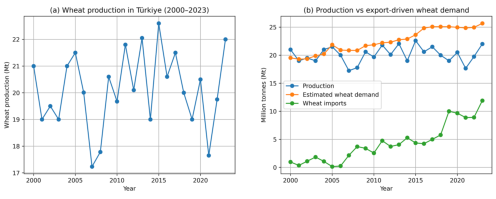
Figure 1: Structure of Türkiye’s wheat system. (a) Annual wheat production in Türkiye between 2000 and 2023. Production fluctuates between approximately 17 and 22 million tonnes, depending largely on climatic conditions affecting rain-fed wheat regions. (b) Domestic wheat production compared with estimated wheat demand generated by domestic consumption and wheat-equivalent volumes required to produce exported flour and pasta. Wheat-equivalent export demand is calculated using a standard flour extraction ratio of 0.75. The figure illustrates that the scale of Türkiye’s export-oriented wheat-processing sector frequently exceeds the domestic production base. Data sources: FAOSTAT trade statistics and national production estimates.
Page 4 of 9
M.L. Kurnaz: Preprint submitted to Elsevier
Import-Dependent Grain Processing Hubs
The scale of export-oriented processing further illustrates this structural relationship. Türkiye exports approximately 3–4 million tonnes of wheat flour annually, corresponding to roughly 4–5 million tonnes of wheat equivalent when standard milling extraction ratios are applied. When combined with domestic consumption, the total wheat volume required to support both domestic and export markets can exceed domestic production in years with weaker harvests.
As a result, the sector relies significantly on imported grain, particularly from major exporting regions in the Black Sea basin. This model has enabled Türkiye to create a highly competitive, export-focused flour industry under stable market conditions. However, it also links the sector’s industrial activity to the availability of imported wheat.
Within the analytical framework introduced above, this configuration corresponds to a relatively low Biophysical Autonomy Ratio (BAR). When domestic wheat production is compared with the total wheat demand generated by domestic consumption and export-oriented processing, BAR values may fall below unity in years with weaker harvests. In such cases, the effective scale of the milling industry depends partly on imported grain supplies.
Figure 2 illustrates this structural relationship through the evolution of Türkiye’s wheat self-sufficiency ratio over the past two decades. The indicator compares domestic wheat production with the total wheat supply available for domestic use. While Türkiye remains a major wheat producer, the expansion of export-oriented processing has increased the role of imported grain in sustaining milling activity. However, this apparent stability conceals an important structural feature: the self-sufficiency ratio does not account for the additional demand generated by exportoriented processing.
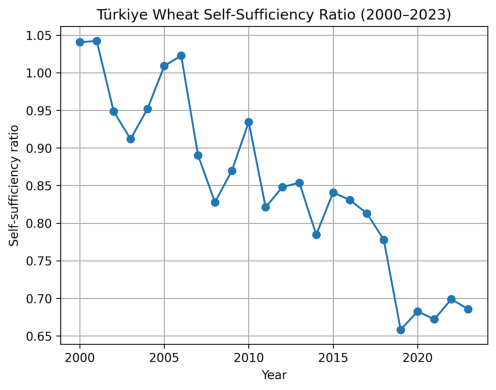
Figure 2: Wheat self-sufficiency ratio in Türkiye, 2000– 2023. The ratio compares domestic wheat production with the total wheat supply available for domestic use (production + imports − exports). Values below one indicate reliance on imported wheat. Data sources: FAOSTAT trade statistics and national production estimates.
6. Empirical results: Structural patterns in the Biophysical Autonomy Ratio
The empirical analysis covers a set of countries selected to represent structurally distinct positions within the global wheat system. Kazakhstan represents a production-surplus exporter whose domestic agricultural base substantially exceeds processing and consumption demand. Egypt represents a large import-dependent consumer that relies structurally on global markets for staple food supply. Germany, Italy, and the Netherlands represent established European processing economies with varying degrees of domestic production capacity. Türkiye is the primary case under examination. This selection is not exhaustive but is intended to situate Türkiye’s BAR trajectory within a range of contrasting system types, allowing structural differences to be identified through comparison rather than in isolation.
Figure 3 reveals clear structural differences in BAR trajectories across wheat system types.
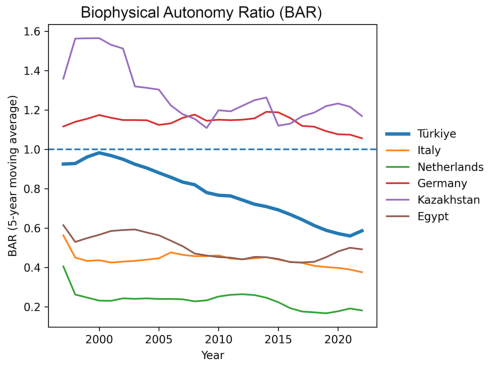
Figure 3: Biophysical Autonomy Ratio (BAR) across wheat system types, 2000–2023. Five-year moving averages are shown to highlight structural trends. The dashed line indicates the structural balance threshold (BAR = 1), where domestic wheat production is sufficient to support both domestic consumption and export-oriented processing demand. Production-surplus systems (e.g. Kazakhstan) maintain BAR values above unity, while import-dependent systems (e.g. Egypt) remain consistently below. Processing hubs exhibit more heterogeneous patterns: Germany and Italy remain relatively stable, and the Netherlands displays structurally low but stable values reflecting importdependent processing. In contrast, Türkiye shows a sustained decline in BAR over time, indicating an increasing divergence between domestic wheat production and the scale of its export-oriented processing sector. Data sources: FAOSTAT production and trade statistics; wheat-equivalent exports calculated using a standard extraction coefficient of 0.75.
Table 1 reports the average BAR value for each country during the initial period (2000–2004) and the most recent period (2019–2023), together with the absolute change over
Page 5 of 9
M.L. Kurnaz: Preprint submitted to Elsevier
Import-Dependent Grain Processing Hubs
Table 1
Average Biophysical Autonomy Ratio (BAR) by country for initial (2000–2004) and recent (2019–2023) periods, and absolute change over the observation window.
| Country | **BAR ** | (2000–2004) | **BAR ** | (2019–2023) | Change | System type |
|---|---|---|---|---|---|---|
| Kazakhstan | 1.51 | 1.22 | −0.29 | Production-surplus | ||
| Germany | 1.15 | 1.08 | −0.07 | Processing hub | ||
| Italy | 0.43 | 0.39 | −0.04 | Processing hub | ||
| Netherlands | 0.24 | 0.19 | −0.05 | Processing hub | ||
| Türkiye | 0.95 | 0.56 | −0.39 | Processing hub | ||
| Egypt | 0.59 | 0.50 | −0.09 | Import-dependent |
the observation window. Among the countries examined, Türkiye exhibits the largest decline in BAR, falling from 0.95 to 0.56, which indicates a pronounced structural divergence between domestic wheat production and the scale of exportoriented processing.
The results reveal clear and consistent differences across system types. Production-surplus systems, represented by Kazakhstan, maintain BAR values consistently above unity throughout the observation period. This indicates that domestic production exceeds the combined demands of domestic consumption and export-oriented processing, reflecting a structural surplus position within the global wheat system.
In contrast, import-dependent systems, exemplified by Egypt, exhibit BAR values that remain persistently below one. These systems rely structurally on imported wheat to meet domestic consumption needs, and their position remains relatively stable over time. This pattern is consistent with their role within the global food trade as net importers of primary agricultural commodities.
Processing hubs occupy an intermediate position but display more heterogeneous dynamics. Countries such as Germany and Italy show relatively stable BAR trajectories, with values fluctuating around or moderately below unity. The Netherlands, which hosts a significant processing sector but has limited domestic agricultural production, exhibits consistently low BAR values. Importantly, these low values reflect a structurally import-dependent processing model rather than a recent deterioration, and they remain broadly stable over time.
Against this background, Türkiye displays a distinct and pronounced trajectory. While BAR values in the early 2000s are close to unity, indicating a relatively balanced relationship between domestic production and processing demand, the ratio has sustained a decline over the subsequent two decades. By the late 2010s and early 2020s, BAR values fell substantially below one, reaching levels comparable to structurally import-dependent systems.
This decline is not characterised by short-term volatility but by a persistent downward trend, indicating a structural decoupling between domestic production and processing capacity. Among the processing hub economies examined, Türkiye displays the most pronounced directional shift over the observation period. While other processing hubs such as Germany and Italy maintain relatively stable BAR trajectories, and the Netherlands exhibits consistently low but stable
values, Türkiye is distinctive in having begun the period in a near-balanced position, with BAR values approaching unity in the early 2000s, and having undergone sustained structural deterioration thereafter. This combination of an initially balanced starting point and a persistent downward trajectory differentiates Türkiye from both structurally stable processing hubs and chronically import-dependent systems and makes it a particularly informative case for examining how processing-led growth can progressively erode biophysical autonomy.
The observed pattern indicates an increasing divergence between industrial capacity and domestic biological production. In practical terms, this implies that a growing share of Türkiye’s wheat processing activity depends on imported grain inputs rather than domestic production. While such a configuration can be economically efficient under stable global market conditions, it also implies greater exposure to external supply dynamics.
According to the analytical framework introduced in this study, the declining BAR trajectory can be interpreted as a reduction in biophysical autonomy. The Turkish wheat processing system has become increasingly reliant on external agricultural systems to sustain its current scale of operation. This structural dependence differentiates Türkiye from both surplus-producing systems and other processing hubs, positioning it as a particularly relevant case for examining the resilience of globally integrated food processing systems under conditions of increasing climate variability.
It is worth noting that Italy and the Netherlands have maintained low BAR values throughout the observation period without apparent disruption to their processing sectors. This suggests that a low BAR level alone does not indicate imminent instability—as noted in the analytical framework, these configurations can be economically sustainable under stable trade conditions. The concern highlighted by Türkiye’s case is distinct: it is the directional shift from nearautonomy toward structural import dependence, occurring over a relatively short timeframe, that warrants attention. A system that has always been import-dependent may have developed adaptive institutional responses—like diversified supplier networks and established reserve mechanisms— that a system undergoing rapid structural change may not yet have in place.
Taken together with Figures 1 and 2, this result demonstrates that the apparent stability suggested by conventional
Page 6 of 9
M.L. Kurnaz: Preprint submitted to Elsevier
Import-Dependent Grain Processing Hubs
indicators conceals a structural divergence that becomes visible only when export-oriented processing demand is explicitly incorporated.
7. Climate risk and supply chain exposure
The vulnerability of trade-dependent food processing systems becomes more apparent when considering the growing climatic instability affecting major global grain-producing regions. Several of the world’s largest wheat-exporting areas—including the Black Sea region, North America, and parts of Europe—have experienced increasing yield variability associated with extreme weather events such as droughts, heat waves, and flooding (Toreti et al., 2019; Kornhuber et al., 2020; Caparas et al., 2021).
A growing body of research highlights the risk of synchronous production shocks, in which multiple agricultural regions experience adverse climatic conditions during the same growing season (Tigchelaar et al., 2018; Gaupp et al., 2020; Anderson et al., 2019). Such events can significantly reduce global wheat availability and contribute to rapid price increases in international grain markets.
Under these conditions, exporting countries may respond by restricting exports to stabilise domestic food prices or protect national food security. Export restrictions played a notable role in amplifying global food price volatility during previous food crises (Headey, 2011; Puma et al., 2015). These policy responses can further tighten global supply and intensify disruptions in international grain trade.
In terms of the analytical framework introduced earlier, such disruptions reduce the effective autonomy of processing systems with low BAR values, whose industrial capacity depends on continued access to imported biological inputs.
For countries with large food processing sectors dependent on imported grain inputs, such dynamics may create significant exposure to supply chain disruptions. Even when domestic agricultural production remains stable, reduced access to imported raw materials can constrain industrial processing activity.
The case of Türkiye’s flour sector illustrates this structural exposure. As discussed in Section 6, the country’s milling industry operates at a scale that frequently exceeds the domestic wheat production base and therefore relies partly on imported grain, particularly from the Black Sea region. If major exporting countries experience simultaneous production shocks or impose export restrictions, the availability of imported wheat could decline rapidly.
These dynamics suggest that the resilience of globally integrated food processing hubs depends not only on domestic agricultural production but also on the stability of international supply chains. As climate-related production variability increases across multiple agricultural regions, the risk of disruptions affecting trade-dependent processing systems may also grow. From a policy perspective, this exposure raises questions about the long-term resilience of
food systems such as Türkiye’s, where large industrial processing capacity coexists with a relatively limited domestic agricultural production base.
8. Policy implications
The findings of this study carry several implications for food system governance in countries hosting large exportoriented processing industries.
A central institutional factor in Türkiye’s case is the Domestic Processing Regime, which permits the tariff-free importation of wheat for processing and subsequent reexport. This framework has been instrumental in enabling the growth of Türkiye’s milling sector and has generated significant export revenue and industrial employment. At the same time, the analysis suggests that the regime has contributed to a structural decoupling between processing capacity and the domestic agricultural production base. As the BAR indicator shows, this decoupling has deepened progressively over the past two decades. Policymakers may therefore wish to consider whether the current design of the regime adequately accounts for long-term supply chain exposure, particularly under conditions of increasing climate variability in major wheat-exporting regions.
This does not necessarily imply a restriction of the regime or a retreat from trade-oriented industrial policy. Rather, it suggests that resilience considerations could be incorporated alongside existing competitiveness objectives. For example, BAR-based monitoring could serve as a diagnostic tool within national food security governance frameworks, helping to identify when the gap between processing capacity and domestic production has widened to a degree that warrants policy attention. Similarly, strategic grain reserve requirements calibrated to the volume of importdependent processing activity could provide a buffer against short-term supply disruptions without fundamentally altering the trade framework.
More broadly, the case illustrates a governance challenge that is not unique to Türkiye. Countries that host large food processing industries operating under import-for-re-export regimes may benefit from periodic assessment of the relationship between industrial capacity and domestic biological production. Existing food security monitoring frameworks tend to focus on consumption-side self-sufficiency and may not fully capture the additional demand generated by exportoriented processing. Incorporating indicators like the BAR into national and international food security assessments could help close this monitoring gap.
These considerations do not imply that trade-dependent processing models are inherently fragile. Under stable global market conditions, such models have demonstrated substantial economic benefits. The concern raised here is more specific: that as climate-related production variability increases across multiple major exporting regions, the structural exposure of import-dependent processing hubs may grow in ways that existing governance frameworks are not well positioned to detect or manage.
Page 7 of 9
M.L. Kurnaz: Preprint submitted to Elsevier
Import-Dependent Grain Processing Hubs
9. Conclusions
This study examined the relationship between domestic agricultural production and export-oriented food processing using the Biophysical Autonomy Ratio (BAR) as an analytical indicator. The concept provides a simplified framework for evaluating the degree to which industrial food processing systems depend on domestic biological production capacity or imported agricultural inputs.
The case of Türkiye’s wheat and flour sector illustrates how large food processing industries can operate at a scale that exceeds the domestic agricultural production base. While Türkiye remains a major wheat producer, the expansion of export-oriented milling has created a structural reliance on imported grain to sustain current levels of industrial activity. Under stable global market conditions, this model has enabled the development of a highly competitive flour export industry.
However, increasing climate variability across major grain-producing regions may affect the reliability of international supply chains. Synchronous production shocks, export restrictions, or disruptions in global grain trade could limit the availability of imported inputs for processing industries dependent on external supply.
These dynamics highlight the importance of evaluating the balance between domestic biological production capacity and industrial processing scale when assessing food system resilience (Tendall et al., 2015). Analytical indicators such as the BAR may help policymakers identify structural dependencies and design strategies that strengthen the resilience of globally integrated food systems while maintaining the benefits of international trade.
In this context, maintaining a minimum level of alignment between industrial processing capacity and domestic biological production may become a central challenge for food system resilience in an increasingly unstable climate.
Declaration of generative AI and AI-assisted technologies in the writing process
During the preparation of this work, the author used AIassisted tools (Claude, ChatGPT, and Gemini) for language editing and structural revision in response to simulated editorial feedback. All scientific content, data collection, empirical analysis, conceptual framework development, and conclusions were developed by the author. The author reviewed and takes full responsibility for all content.
CRediT authorship contribution statement
M. Levent Kurnaz: Conceptualization, Methodology, Formal analysis, Writing – Original Draft, Writing – Review & Editing.
References
Allan, J., 1998. Virtual water: a strategic resource. Ground Water 36, 545– 546. doi:10.1111/j.1745-6584.1998.tb02825.x.
-
Anderson, W., Seager, R., Baethgen, W., Cane, M., You, L., 2019. Synchronous crop failures and climate-forced production variability. Science Advances 5, eaaw1976. doi:10.1126/sciadv.aaw1976.
-
Asseng, S., Ewert, F., Martre, P., Rötter, R., Lobell, D., Cammarano, D., Kimball, B., Ottman, M., Wall, G., White, J., Reynolds, M., Alderman, P., Prasad, P., Aggarwal, P., Anothai, J., Basso, B., Biernath, C., Challinor, A., De Sanctis, G., Doltra, J., Fereres, E., Garcia-Vila, M., Gayler, S., Hoogenboom, G., Hunt, L., Izaurralde, R., Jabloun, M., Jones, C., Kersebaum, K., Koehler, A.K., Müller, C., Naresh Kumar, S., Nendel, C., O’Leary, G., Olesen, J., Palosuo, T., Priesack, E., Eyshi Rezaei, E., Ruane, A., Semenov, M., Shcherbak, I., Stöckle, C., Stratonovitch, P., Streck, T., Supit, I., Tao, F., Thorburn, P., Waha, K., Wang, E., Wallach, D., Wolf, J., Zhao, Z., Zhu, Y., 2014. Rising temperatures reduce global wheat production. Nature Climate Change 5, 143–147. doi:10.1038/nclimate2470.
-
Biess, B., Gudmundsson, L., Windisch, M., Seneviratne, S., 2024. Future changes in spatially compounding hot, wet or dry events and their implications for the world’s breadbasket regions. Environmental Research Letters 19, 064011. doi:10.1088/1748-9326/ad4619.
-
Bren d’Amour, C., Wenz, L., Kalkuhl, M., Steckel, J., Creutzig, F., 2016. Teleconnected food supply shocks. Environmental Research Letters 11, 035007. doi:10.1088/1748-9326/11/3/035007.
-
Caparas, M., Zobel, Z., Castanho, A., Schwalm, C., 2021. Increasing risks of crop failure and water scarcity in global breadbaskets by 2030. Environmental Research Letters 16, 104013. doi:10.1088/1748-9326/ ac22c1.
-
Chatzopoulos, T., Pérez Domínguez, I., Toreti, A., Adenäuer, M., Zampieri, M., 2021. Potential impacts of concurrent and recurrent climate extremes on the global food system by 2030. Environmental Research Letters 16, 124021. doi:10.1088/1748-9326/ac343b.
-
Clapp, J., 2017. Responsibility to the rescue? Governing private financial investment in global agriculture. Agriculture and Human Values 34, 223–235. doi:10.1007/s10460-015-9678-8.
-
Cottrell, R., Nash, K., Halpern, B., Remenyi, T., Corney, S., Fleming, A., Fulton, E., Hornborg, S., Johne, A., Watson, R., Blanchard, J., 2019. Food production shocks across land and sea. Nature Sustainability 2, 130–137. doi:10.1038/s41893-018-0210-1.
-
Deteix, L., Salou, T., Loiseau, E., 2024. Quantifying food consumption supply risk: an analysis across countries and agricultural products. Global Food Security 41, 100764. doi:10.1016/j.gfs.2024.100764.
-
Fader, M., Gerten, D., Thammer, M., Heinke, J., Lotze-Campen, H., Lucht, W., Cramer, W., 2011. Internal and external green-blue agricultural water footprints of nations, and related water and land savings through trade. Hydrology and Earth System Sciences 15, 1641–1660. doi:10. 5194/hess-15-1641-2011.
-
Francis, J., Vavrus, S., 2012. Evidence linking Arctic amplification to extreme weather in mid-latitudes. Geophysical Research Letters 39, L06801. doi:10.1029/2012GL051000.
-
Gaupp, F., Hall, J., Hochrainer-Stigler, S., Dadson, S., 2020. Changing risks of simultaneous global breadbasket failure. Nature Climate Change 10, 54–57. doi:10.1038/s41558-019-0600-z.
-
Gaupp, F., Hall, J., Mitchell, D., Dadson, S., 2019. Increasing risks of multiple breadbasket failure under 1.5 and 2[◦] C global warming. Agricultural Systems 175, 34–45. doi:10.1016/j.agsy.2019.05.010.
-
Hasegawa, T., Wakatsuki, H., Nelson, G., 2022. Evidence for and projection of multi-breadbasket failure caused by climate change. Current Opinion in Environmental Sustainability 58, 101217. doi:10.1016/j.cosust.2022. 101217.
-
Headey, D., 2011. Rethinking the global food crisis: the role of trade shocks. Food Policy 36, 136–146. doi:10.1016/j.foodpol.2010.10.003.
-
Heino, M., Guillaume, J., Müller, C., Iizumi, T., Kummu, M., 2020. A multi-model analysis of teleconnected crop yield variability in a range of cropping systems. Earth System Dynamics 11, 113–128. doi:10.5194/ esd-11-113-2020.
-
Hoekstra, A., Hung, P., 2005. Globalisation of water resources: international virtual water flows in relation to crop trade. Global Environmental Change 15, 45–56. doi:10.1016/j.gloenvcha.2004.06.004.
Page 8 of 9
M.L. Kurnaz: Preprint submitted to Elsevier
Import-Dependent Grain Processing Hubs
-
Keys, P., Barnes, E., Diffenbaugh, N., Hertel, T., Baldos, U., Hedlund, J., 2025. Exposure to compound climate hazards transmitted via global agricultural trade networks. Environmental Research Letters 20, 044039. doi:10.1088/1748-9326/adb86a.
-
Kornhuber, K., Coumou, D., Vogel, E., Lesk, C., Donges, J., Lehmann, J., Horton, R., 2020. Amplified Rossby waves enhance risk of concurrent heatwaves in major breadbasket regions. Nature Climate Change 10, 48–53. doi:10.1038/s41558-019-0637-z.
-
Lesk, C., Rowhani, P., Ramankutty, N., 2016. Influence of extreme weather disasters on global crop production. Nature 529, 84–87. doi:10.1038/ nature16467.
-
Lobell, D., Bänziger, M., Magorokosho, C., Vivek, B., 2011. Nonlinear heat effects on African maize as evidenced by historical yield trials. Nature Climate Change 1, 42–45. doi:10.1038/nclimate1043.
-
Mehrabi, Z., Ramankutty, N., 2019. Synchronized failure of global crop production. Nature Ecology & Evolution 3, 780–786. doi:10.1038/ s41559-019-0862-x.
-
Puma, M., Bose, S., Chon, S., Cook, B., 2015. Assessing the evolving fragility of the global food system. Environmental Research Letters 10, 024007. doi:10.1088/1748-9326/10/2/024007.
-
Qi, W., Feng, L., Yang, H., Liu, J., 2022. Increasing concurrent drought probability in global main crop production countries. Geophysical Research Letters 49, e2021GL097060. doi:10.1029/2021GL097060.
-
Raymond, C., Horton, R., Zscheischler, J., Martius, O., AghaKouchak, A., Balch, J., Bowen, S., Camargo, S., Hess, J., Kornhuber, K., Oppenheimer, M., Ruane, A., Wahl, T., White, K., 2020. Understanding and managing connected extreme events. Nature Climate Change 10, 611– 621. doi:10.1038/s41558-020-0790-4.
-
Rulli, M., Saviori, A., D’Odorico, P., 2013. Global land and water grabbing. Proceedings of the National Academy of Sciences 110, 892–897. doi:10. 1073/pnas.1213163110.
-
Schauberger, B., Archontoulis, S., Arneth, A., Balkovic, J., Ciais, P., Deryng, D., Elliott, J., Folberth, C., Khabarov, N., Müller, C., Pugh, T., Rolinski, S., Schaphoff, S., Schmid, E., Wang, X., Schlenker, W., Frieler, K., 2017. Consistent negative response of US crops to high temperatures in observations and crop models. Nature Communications 8, 13931. doi:10.1038/ncomms13931.
-
Tendall, D., Joerin, J., Kopainsky, B., Edwards, P., Shreck, A., Le, Q., Krütli, P., Grant, M., Six, J., 2015. Food system resilience: defining the concept. Global Food Security 6, 17–23. doi:10.1016/j.gfs.2015.08.001.
-
Tigchelaar, M., Battisti, D., Naylor, R., Ray, D., 2018. Future warming increases probability of globally synchronized maize production shocks. Proceedings of the National Academy of Sciences USA 115, 6644–6649. doi:10.1073/pnas.1718031115.
-
Toreti, A., Cronie, O., Zampieri, M., 2019. Concurrent climate extremes in the key wheat producing regions of the world. Scientific Reports 9, 5493. doi:10.1038/s41598-019-41932-5.
-
Zhao, C., Liu, B., Piao, S., Wang, X., Lobell, D., Huang, Y., Huang, M., Yao, Y., Bassu, S., Ciais, P., Durand, J.L., Elliott, J., Ewert, F., Janssens, I., Li, T., Lin, E., Liu, Q., Martre, P., Müller, C., Peng, S., Peñuelas, J., Ruane, A., Wallach, D., Wang, T., Wu, D., Liu, Z., Zhu, Y., Zhu, Z., Asseng, S., 2017. Temperature increase reduces global yields of major crops in four independent estimates. Proceedings of the National Academy of Sciences 114, 9326–9331. doi:10.1073/pnas.1701762114.
Page 9 of 9
M.L. Kurnaz: Preprint submitted to Elsevier